Our previous home in Virginia sat high on a bluff overlooking the Potomac River. Tall trees surrounded the property, and countless species of birds passed through or lived there. Occasionally I would hear a call I could not identify, from a bird I could never see. Every now and then from high in the thick canopy of old walnut, oak, and black locust I would hear a gentle, evenly spaced series of soft calls. The source seemed to be the very tops of hundred-foot-tall trees and was always so muted I had to stop walking to be sure I heard it. Imagine a leaf in early autumn falling away and drifting with half breeze, half gravity, slowly making its way past countless other leaves, getting held up here and there before finally reaching the open air. Finally free of the hindrance of other branches it traces lazy arcs through the air like a pendulum before silently coming to rest on the ground. That's the level of urgency the sound of this call seemed to share to reach my ears.
Before the dawn of bird call sound ID apps like Merlin (10/10 would recommend), my preferred scientific method to identify birds heard but not seen would be to ask whoever I was with, "Hey did you hear that?" Sometimes followed by, "what *is* that?" As luck would have it, in 2017 I was hiking with my photographer/naturalist friend Nicole when I heard it and asked her. She knew instantly what it was: a yellow-billed cuckoo. She proceeded to tell me three more things about them: they're nearly impossible to photograph because they stay high up in the canopy, they eat tent caterpillars, and she loves them too.
Two years later I was doing some work on a hunting blind in the woods on our property and I saw a small, nondescript fledgling bird fall from very high in a nearby tree, and watched it snag a tiny branch at eye level about twenty feet away from me. I had no idea if the jump/fall was a premature accident or a scheduled departure from the nest. When the parent followed a moment later, I was relieved to see the little tyke was in good hands and absolutely delighted that the birds involved were in fact the elusive yellow-billed cuckoos. I could finally put a face to the name and voice.
I continued to hear them in our woods every summer and fall, their call always making me stop what I was doing to bask in the gentleness of those distant encounters. But early last year we moved away and settled farther south in eastern North Carolina. Since then, on a few occasions I have heard that gentle call again down here. Always in the same heavily wooded area a mile or two from the house. And always, of course, from high in the canopy. I love knowing they nest here. But as elusive as they are, and as rarely as I've heard them here, I never expected to see one again.
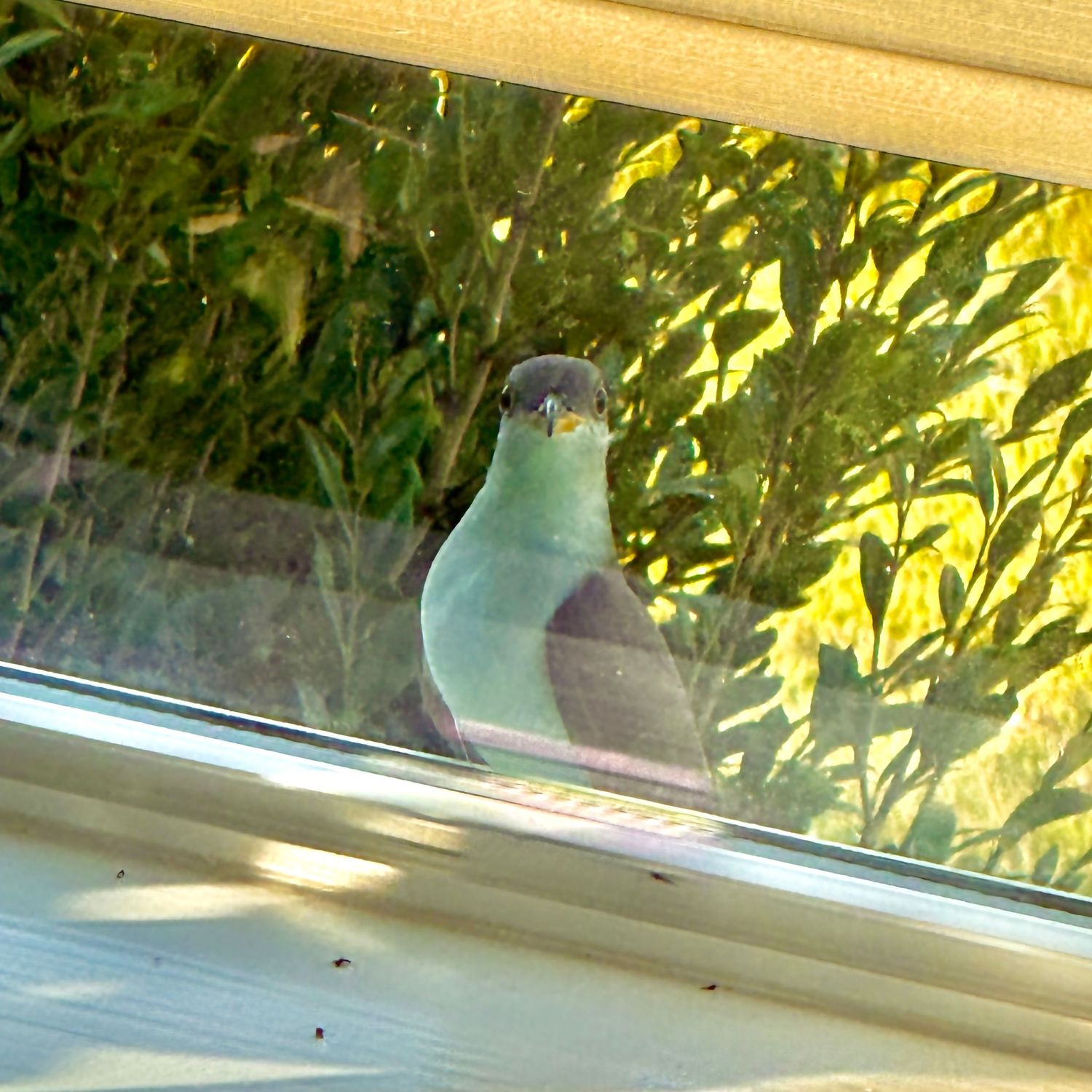
Two days ago, I was standing in our dining room doing nothing other than trying to remember why I walked in there. I heard a small disturbance at the window and turned to look. It took my eyes a moment to sort the glare and light to focus on the space just beyond the glass. Sitting on the outside ledge of the window I saw – for only the second time in my life – my favorite, gentle bird. I watched, frozen, not wanting to sabotage the encounter. But the bird was in no hurry to flit away. In fact – and while this may well be met with skepticism but I'm telling you it's true – it watched me back. Even as I took out my phone to capture a photo, it watched undisturbed.
I read more about yellow-billed cuckoos. In Appalachian folklore and throughout the American south they have long been referred to as Rain Crows for their propensity to call before summer storms. My visitation did in fact occur a day before a major rain event, but that evidence is (like most evidence on this topic, I imagine) purely anecdotal.
There is an ancient Celtic philosophy that describes 'Thin Places,' moments when the distance between your inner life and the outer world – from overwhelming grand landscapes to close, intimate encounters with nature – narrows. My interaction with these birds, and more to the point with *this* bird through that window, feels very much like a Thin Place.
Did the bird that is always heard and not seen choose to be seen and not heard for some reason? Almost certainly not. It's more likely he arrived at the dining room just the same as I did – trying to remember why he went there.
In the end I can't recall which one of us decided the encounter was over, that the transaction – whatever was exchanged through that pane of glass – was complete. But eventually it was. And I am left to ponder what to make of it all.